Mistake #1: You avoid all animal protein.
Why it’s aging you: You may lack of vitamin B12. which is essential for energy.
Found only in foods that are derived from animals, this nutrient helps regulate your metabolism and energy production and is key to maintaining a healthy brain and nervous system. “Fatigue is a classic sign of B12 deficiency, which usually occurs in people who don’t eat very much animal protein,” says Danine Fruge, MD, associate medical director of the Pritikin Longevity Center & Spa in Miami. Chewing a lot of antacids to relieve heartburn can also lead to B12 deficiency because antacids interfere with B12 absorption.
Food Fix: Have two servings of nonfat dairy foods, such as fat-free milk or nonfat yogurt, and 3 to 4 ounces of lean protein daily. Good sources of B12 include seafood such as fish, clams, oysters, and mussels, as well as lean beef and pork, chicken, and fortified cereal.
Supplement Solution
Take 500 to 1,000 mcg of vitamin B12 in tablet form every day to raise and maintain your B12 levels.
Inspiring chicken dinners that are weeknight-quick! Mistake #2:You avoid supplements.
Why it’s aging you: You miss manganese and copper, which help prevent joint pain.
Because manganese and copper are both essential for maintaining joint cartilage and flexibility, “in most cases, supplementing these nutrients reverses the joint deterioration and eliminates the pain,” says Dale Peterson, MD, director of the Comprehensive Wellness Center in Sapulpa, OK. “The body can actually repair a significant amount of damage if it’s given the proper support.”
Food Fix: Nuts, beef, and spinach are good sources of these nutrients, but you won’t be able to eat enough to get all your copper and manganese, so opt for a supplement, Dr. Peterson advises. Take 2 mg of copper and 5 mg of manganese each day. Within 2 to 3 months, your joints should feel less painful.
Supplements that help you avoid disease Mistake #3: You avoid fish and fat.
Why it’s aging you: Fish and healthy oils (like olive) offer the best source of omega-3 essential fatty acids ,which help prevent memory loss.
“These fatty acids are part of the brain’s building blocks,” explains Andrew Weil, MD, director of the Center for Integrative Medicine at the University of Arizona. “If you’re not getting enough in your diet, the architecture of the brain becomes weak, and brain function, including memory, suffers.” But it’s not only the amount of omega-3s that’s important; the balance between omega-3s and omega-6s is equally crucial. “Our diets are flooded with omega-6 fatty acids, mostly from processed foods,” says Dr. Weil. “The more omega-6s you eat, the more omega-3s you need to balance your levels. Most of us aren’t eating enough omega-3s and are eating too many omega-6s.”
Food Fix: First, reduce your consumption of refined and processed foods much as possible, and cook with olive or canola oil. Then, eat 3 1⁄2 ounces of wild salmon and 3 1⁄2 ounces of herring, sardines, or halibut each week. Add 2 tablespoons of freshly ground flaxseed to cereal, whole grain side dishes, or shakes daily, and garnish salads or cereal with 1 tablespoon of walnuts 5 days a week. Finally, enjoy 9 to 12 almonds 4 times a week.
Supplement Solution
Take at least 2,000 mg of fish oil daily.
Look for 1,000 mg capsules of combined docosahexaenoic acid (DHA) and eicosapentaenoic acid (EPA).
A salmon burger non fish- fans will crave! Mistake #4:You favor packaged foods over whole.
Why it’s aging you: Packaged foods are high in blood pressure–spiking sodium—and fresh fruits and veggies contain blood pressure–lowering potassium.
“Having too little potassium in your diet magnifies the toxic effects of excessive salt intake,” Dr. Fruge says. Most processed foods have added sodium but no extra potassium, so if your meals come from boxes, you’re likely at risk. Worsening the situation, when your kidneys try to flush out the salt, you lose even more potassium. “The imbalance damages blood vessels, driving up blood pressure,” Dr. Fruge notes. “Eating better can correct the problem—I’ve seen people drop thirty points in three days.”
Food Fix: Cut your sodium consumption to no more than 1,500 mg per day, and eat seven to nine servings of fruits and vegetables every day.
Every child born in Canada should be screened for hearing loss right after birth, so that potential problems can be addressed early, Canada's pediatricians say.
A made-in-Canada urine test appears to be able to spot the signs of early colorectal cancer, and might eventually do away with less appealing screening methods.
Chocolate milk has long been seen as the spoonful of sugar that makes the medicine go down, but the nation's childhood obesity epidemic has a growing number of people wondering whether that's wise.
CTV's Pauline Chan talks to a doctor who is witnessing more and more dark skinned patients with the signs of melanoma. He shares some helpful tips for those looking to protect themselves.
ATLANTA — The United States seems to be on track to have more measles cases than any year in more than a decade, with virtually all cases linked to other countries, including Europe where there's a big outbreak.
Already there have been 89 cases reported so far. The U.S. normally sees only about 50 cases of measles in a year thanks to vaccinations.
Health officials are reluctant to make predictions, but acknowledge the pace of reports is unusually hot.
"It's hard to say, but we're certainly getting a lot," said Dr. Greg Wallace, who leads the measles, mumps, rubella and polio team at the U.S. Centers for Disease Control and Prevention.
Europe, especially France, has been hit hard by measles, with more than 6,500 cases reported in 33 nations. International health officials are blaming it on the failure to vaccinate all children.
Just about all U.S. outbreaks were sparked by people bringing it here from other countries. This week, international health officials posted an alert urging travellers everywhere to get the recommended two doses of vaccine before flying overseas.
"The risk of getting infection is very high," said Dr. Cuauhtemoc Ruiz Matus, an immunization expert with the Pan American Health Organization.
Measles is highly contagious and up to 90 per cent of people exposed to an infected person get sick, experts say. The virus spreads easily through the air, and in closed rooms, infected droplets can linger for up to two hours after the sick person leaves.
"Measles is really the most contagious of the vaccine-preventable diseases. It has a knack for finding those who have not been vaccinated," Wallace said.
The disease's most common symptoms include fever, runny nose, cough, eye inflammation and rash all over the body. It takes about two weeks for the rash to appear from the time of first infection, and people are contagious from four days before a rash to four days after.
A small fraction of people get much sicker, developing pneumonia or even encephalitis. For every 1,000 children who get measles in developed nations, one or two will die.
In the U.S., the worst year for measles in the last decade was 2008, when 140 cases were reported. There have been no measles deaths this year, but health officials warn the disease can be dangerous.
Since 2003, there have been no measles-related deaths reported in the United States, where children have been getting vaccinated against the virus for almost 50 years. Before the vaccine, nearly all children got measles by their 15th birthday and epidemics cycled through the nation every two to three years -- generally peaking in the late winter or spring.
In those days, about 450 to 500 Americans died from measles each year, on average. Vaccination campaigns reduced the toll dramatically, and today, roughly 90 per cent of U.S. kids are protected from measles, according to studies of teenagers.
While Prince William may have more on his mind this week than his hairline, Pauline Chan investigates solutions for young men like him whose hairlines have started to recede early.
Men under 65 with early prostate cancer had better survival odds if they had surgery right away instead of waiting for treatment only if their cancer got worse, a study in Sweden found.
That was true even for tumours thought to be low-risk because they didn't look very aggressive under a microscope.
Doctors have long debated whether and how to treat such early cases, and the study shows "there clearly is a benefit to getting the cancer out in the younger population," said Dr. Richard Greenberg, urology chief at Fox Chase Cancer Center in Philadelphia.
But there's a big caveat: The benefit may depend on how a man is diagnosed.
About 95 per cent of the cancers in the Swedish study were found because they were causing symptoms. In the United States, however, most are found after a PSA blood test suggests a problem, long before symptoms appear. Most of these cancers will not prove life-threatening, but there's no sure-fire way to tell which ones will, so many men get treatment they may not need.
The study is one of the longest-running attempts to look at this issue. It was led by researchers at University Hospital in Uppsala and the Karolinska Institute in Stockholm, and paid for by the U.S. National Institutes of Health and the Swedish Cancer Society. Results appear in Thursday's New England Journal of Medicine.
Starting in 1989, nearly 700 men under 75 were assigned to have surgery right away or to be monitored and treated if their cancer got worse. Most were having symptoms -- urinary problems, blood in the urine or semen, trouble getting an erection, or pain in the lower back, hips or upper thighs.
After about 13 years of follow-up, there were fewer deaths among those who had surgery -- 166 versus 201 of those being monitored. Prostate cancer was the cause for 55 and 81 of the deaths, respectively.
That means surgery lowered the risk of dying of prostate cancer within 15 years by 38 per cent, researchers calculated. But the benefit was significant only for men under 65. In that age group, only seven men would need to be treated to save one life.
More men in the group initially assigned to monitoring saw their cancer spread beyond the prostate, and more of them wound up taking hormone treatments as a result.
Surgery had side effects -- 58 per cent of men reported at least some sexual problems and 32 per cent had some urinary trouble. Researchers did not report how many men in the monitoring group had these problems, which are common as men age even if they don't have prostate cancer.
Surgery techniques have improved since the study began, and nerve-sparing approaches to minimize side effects are more common now.
The study "has provided important evidence that effective treatment is both necessary and possible for many men with early-stage prostate cancer," Dr. Matthew R. Smith of Massachusetts General Hospital wrote in an editorial in the journal.
But whether surgery benefits men with early cancers detected through PSA tests rather than symptoms remains to be seen, he added.
Two studies, one in the United States and one in the United Kingdom, are looking at this now, and include other options besides surgery, he notes.
About half of the 218,000 men diagnosed in the United States each year with prostate cancer have early, low-risk disease, and most choose to treat it right away with surgery, radiation or hormones. In Europe, most choose monitoring and treatment only if it gets worse.
Regularly staying up late at night and sleeping in the next day could put you at risk for gaining weight.
A new study finds that "late sleepers" tend to eat more, weigh more, and eat more low-quality food – even if they get roughly the same amount of sleep as people who hit the hay at a more normal time.
For the small study, which appears in the journal Obesity, scientists from Northwestern University looked at 51 adults: 23 late sleepers and 28 normal sleepers.
The participants recorded their eating and sleep habits in logs for at least seven days. They also wore a wrist actigraph, which monitors sleep and activity cycles.
Late sleepers went to sleep at an average time of 3:45 a.m. and woke up by 10:45 a.m. They ate breakfast at noon, lunch at 2:30 p.m., and dinner at 8:15 p.m. They also ate a "final meal" at 10 p.m.
Normal sleepers on average were up by 8 a.m., ate breakfast by 9 a.m., lunch at 1 p.m., dinner at 7 p.m., a late snack at 8:30 p.m. and were asleep by 12:30 a.m.
Both groups got roughly the same amount of sleep: 7 hours in the late sleep group, and 7.5 in the regular sleepers.
The researchers found that late sleepers took in 248 more calories a day, twice as much fast food and half as many fruits and vegetables as those with earlier sleep times. They also drank more full-calorie soft drinks.
Co-lead author Kelly Glazer Baron, a health psychologist and a neurology instructor at Northwestern University Feinberg School of Medicine, suggested those extra 248 calories can add up over time.
"The extra daily calories can mean a significant amount of weight gain – two pounds per month – if they are not balanced by more physical activity," she said in a news release.
Indeed, the late sleepers had an average higher body mass index, or BMI, than normal sleepers.
The study authors say that the calories that were taken in after dinner were the most problematic.
"Calories consumed after 8:00 p.m. predicted BMI after controlling for sleep timing and duration," they write.
Senior author Dr. Phyllis Zee, a professor of neurology and director of the Sleep and Circadian Rhythms Research Program at Feinberg and medical director of the Sleep Disorders Center at Feinberg and Northwestern Memorial Hospital says eating when the body expects to be sleeping may disturb our circadian rhythms.
"Human circadian rhythms in sleep and metabolism are synchronized to the daily rotation of the earth, so that when the sun goes down you are supposed to be sleeping, not eating," Zee said.
"When sleep and eating are not aligned with the body's internal clock, it can lead to changes in appetite and metabolism, which could lead to weight gain."
The research findings could be relevant to people who have trouble losing weight, suggesting that going to bed early could prevent overeating at night.
The findings also have relevance for night-shift workers, who eat at the "wrong" time of day related to their bodies' circadian rhythms.
"It's midnight, but they're eating lunch," Zee said. "Their risk for obesity as well as cardiovascular, cerebrovascular and gastrointestinal disorders is higher."
Northwestern researchers are now planning more studies to test the findings in a larger group. They also want to try to understand the biological mechanisms that link the relationship between circadian rhythms, sleep timing and metabolism.
The research was supported by the National Heart, Lung and Blood Institute of the National Institutes of Health.
A large new study finds that kids who were still being put to bed with a bottle of milk at age two were more than 30 per cent more likely to be obese by the time they were five.
The Status of Food Enzymes in Digestion & Metabolism
Enzymes are essential to digestion. They break larger food molecules into smaller molecules that the body absorbs as nutrients. The human body typically produces most of the digestive enzymes we need, but they are also present in raw foods. Different enzymes help digest different types of food. Lipase, for example, digests fats while protease digests protein and amylase breaks down starch.
Deficiencies
Many people lack a specific enzyme necessary to digest particular foods. People who are lactose intolerant, for example, cannot properly digest milk or milk products. Sugar and other carbohydrates cause problems for people who are galactose or fructose intolerant.
Gastrointestinal Problems
Gastrointestinal problems occur when there aren't enough enzymes to properly break down the amount or types of foods consumed. The typical American diet consists of cooked and processed foods, which contain only small amounts of active enzymes. Digestion must then be accomplished by the body's enzymes alone. This may result in reduced nutrient absorption as well as bloating, diarrhea, constipation, cramps and heartburn, according to Nutraceuticals World. It may also be a contributing factor to depression, fatigue, attention-deficit/hyperactivity disorder, dull skin and premature aging, according to Better Nutrition magazine.
Supplements
Many enzyme supplements are on the market today. Foods can also be used to aid digestion. Raw foods are naturally rich in enzymes, especially when eaten soon after they are harvested. Avocado is rich in lipase, the enzyme that digests fat. Miso, a fermented soy bean product and excellent flavor enhancer, is also rich in enzymes as long as it is not cooked. Peppermint tea, fresh ginger and devil's claw also may act as a digestive aid and are frequently used to alleviate indigestion.
Digesting Beans
The human body does not produce the enzymes needed to completely digest beans and some other complex carbohydrates. Bacteria in the lower gut use their own enzymes to feed on the undigested particles. Gases are a byproduct of this process.
Breastfeeding Benefits
Breast milk not only contains the proper proportions of protein, carbohydrate and fat, it also contains digestive enzymes not found in formula. This may be why breast-fed babies have fewer intestinal problems than bottle-fed infants, according to Odyssey magazine.
Lipase is a special enzyme in the body that is used to break down fat into smaller fatty acids. Produced by the pancreas, an elevated level of lipase typically denotes a problem with the pancreas itself; However, elevated lipase levels can also be a symptom of a host of other disorders as well.
Pancreatitis
The most common reason why a patient may have an elevated lipase level is if they are suffering from pancreatitis. Pancreatitis is the inflammation of the pancreas. Within the first 48 hours of acute pancreatitis, lipase levels can increase three times or more their normal levels according to a 2006 study in the Emergency Medicine Journal. During pancreatitis inflammation of the tissue makes the pancreas more permeable. This allows more of the lipase enzyme to exit the pancreas into the bloodstream.
Duct Obstruction
Levels of lipase may also become elevated if the pancreatic duct becomes obstructed. This can occur from stones, edema, or in serious cases, tumors. Once the duct become obstructed, pressure increases inside the duct forcing the lipase into the spaces of the pericapillary. This in turn increases the amount of lipase enzyme in the blood.
Medications
Certain medications may also cause an increase in your lipase levels. Before taking a lipase test you should inform your doctor if you are taking the following medications: codeine, morphine, methacholine, indomethacin, cholinergics, meperidine, or bethanechol. Each of these medications can cause an increased reading of lipase in the results of a lipase blood test.
Other
When lipase levels increase by less than five time their normal rates, other disorders or disease outside of the pancreas may be the cause, according to the Gale Encyclopedia of Nursing and Allied Health. In these cases an elevated lipase test can be a sign of bowel obstruction, renal failure, or a peptic ulcer. To validate these possible theories of diagnosis, further testing must be done.
IBS and Stress
Whether you have IBS or not, you're probably familiar with the "butterflies in the stomach" that accompany public speaking, a college final, or other high-stakes events. Stress may trigger or worsen symptoms of IBS. This means that stress can be particularly problematic for people with IBS. IBS symptoms can cause stress, and stress can make the symptoms worse, leading to a vicious cycle.
Treating IBS: Diet Changes
Your treatment strategy will depend on your specific symptoms and triggers, but many people start with diet changes. You may find it helpful to avoid caffeine, alcohol, and fatty foods. Getting more fiber or water may also improve symptoms. Suspicious foods can be eliminated one at a time. It may take some trial and error to discover which changes provide the most relief.
Treating IBS: Probiotics
Probiotics are friendly bacteria that help reduce the growth of harmful organisms in the digestive tract. There are many kinds of probiotics, but the best known is the type found in yogurt — look for a label that says "active cultures." Some studies suggest probiotics may reduce the occurrence of diarrhea, but more research is needed to determine whether this includes symptoms caused by IBS.
Treating IBS: Drugs for Constipation
Occasionally, your doctor may prescribe medication to boost the amount of fluid in the intestines. You can also ask your doctor about over-the-counter laxatives, such as Milk of Magnesia or Miralax, which make the stool softer and easier to pass. Stimulant laxatives such as Correctol and Senokot speed up the motion of stool through the intestines, but should not be used regularly.
Treating IBS: Peppermint Oil
If you prefer a natural remedy, peppermint oil is worth a try. Studies suggest that it may be effective in relieving IBS symptoms. In fact, it performed better than a placebo at relieving symptoms in some people with IBS. Look for enteric-coated capsules, which are less likely to cause heartburn — and check with your doctor first if you're taking other medications.
What Is Irritable Bowel Syndrome?
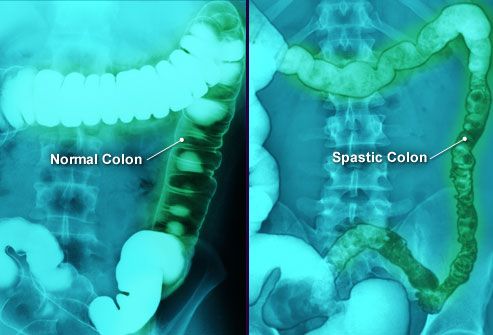
Irritable bowel syndrome (IBS), also known as "spastic colon," is a common disorder. While most people experience digestive troubles once in a while, what sets IBS apart is belly pain and diarrhea or constipation that comes back again and again. IBS affects 10% to 15% of people in North America.
Symptoms of IBS
The main symptoms of IBS are abdominal pain accompanied by a change in bowel habits. This can include constipation, diarrhea, or both. Gas and a visibly bloated belly are also common. The condition does not damage the digestive system, but persistent pain and frequent trips to the bathroom can interfere with everyday life.
Causes of IBS
Doctors don't know the exact cause of IBS. One theory is that the signals between the brain and intestines are somehow disrupted. This miscommunication may cause abnormal intestinal muscle contractions (seen on the right) that result in cramping, pain, and fluctuations in the speed of digestion. Patients have no sign of inflamed or damaged tissue or structural abnormalities in the digestive tract.
IBS: Who's at Risk?
Anyone can get IBS, but the condition is twice as common in women as in men. It's also more likely to affect people who have a family history of IBS. Symptoms usually begin when people are in their late 20s. It's uncommon for people over 50 to develop IBS for the first time. IBS sometimes co-exists with depression or anxiety.
Diagnosing IBS
There is no standard test to check for IBS. Doctors usually make a diagnosis based on a patient's description of the symptoms. For this reason, it's important to be candid and specific about the problems you are having. Your doctor may order tests to rule out other causes of your symptoms.
IBS: Impact on Daily Life
IBS may not put your life at risk, but it can take a significant toll on your lifestyle. During episodes of frequent, urgent diarrhea, you may find it difficult to commute to work or travel by air. You may find it necessary to map out bathrooms before going anyplace new. In severe cases, patients may become hesitant to eat out, see a movie, or socia
Do you suffer from chronic gas? If so then today I'll discuss 3 things you must do in order to stop the creation of excessive gas in your bowels and return your digestive tract to healthy functioning ability. First did you know that the #1 cause of digestive problems is created through a lifestyle of poor dietary habits and prescription or OTC drug use. If either or both apply to you then you will need to address these issues if you wish to stop the gas. The 3 Steps to Ending Chronic Gas #1. Stop Eating Processed Food: At the very least reduce your consumption of processed food, it's entirely likely that you are reacting to a artificial flavour or additive which is causing irritation in your digestive tract and gas as a result. The only way to correct this is to clean up your diet and take on a diet of whole foods for 2 weeks and see how you feel. #2. Get the Bowels Moving: Most people who suffer from chronic gas have one thing in common, they're all constipated! You might not know it, but if you only have 1-2 bowel movements per day and sometimes less you're actually considered constipated. 2-3 is the minimum per day you should be having. 4-5 During a cleanse to ensure everything is out. So do yourself a favour and start drinking some high fiber shakes, they may cause an increase in gas initially but they'll clear everything out and get you back to normal. #3. Eliminate your Candida Overgrowth: If gas is a problem for you, you have a candida overgrowth. There are no ifs, ands or buts about it. This pervasive yeast causes a huge list of symptoms which cover mental, emotional and most of all physical problems. Candida exists in over 90% of the population, a smaller percentage suffer from symptoms due to it. The yeast creates a great deal of fermentation which creates loads of gas, so if you get bloated a lot as well that's a huge sign that you've got a big problem with it. Candida also inhibits enzyme production and reduces stomach acid production creating digestive problems right from the get go in your stomach, not to mention it also suppresses the production of friendly bacteria which are meant to protect your digestive tract from it.
The best thing you can do is begin to follow an anti-candida diet which starves the yeast, this diet is also incredibly healthy as it removes the toxic foods which can contribute to poor bowel health while also improving the overall health of your body. You don't want to delay in treating candida since it's been found that people with cancer virtually always have candida, and that there is a connection between the fermentation process candida creates and cancer growth in the body.
CandidaSymptoms,
The most common causes are overuse of antibiotics (which tend kill the helpful bacteria in the gut), stress and poor diet, and the big one which is frequently overlooked: poor digestion! If you're not "going" frequently or feel like food is simply sitting inside you like dead weight instead of moving through you like a well-oiled machine, then you may fall under the poor digestion category.
How do we improve digestion? A great way is to take digestive enzymes, which help your body break the food you eat (and also improve nutrient absorption at the same time). Two of the most important enzymes to take are bromelain and papain. They are naturally found in pineapples and papayas, respectively. Head to your local health food store or find a reputable online shop and pick up a supplement containing both bromelain and papain. A tablet should be taken before having a big meal. Bromelain/papain supplements are good in general, whether you suffer from candida or not because they help to break down hard to digest proteins (like red-meat!) Most of the people I correspond with seem to have some sort of digestion or indigestion issue.
We also want to make sure food is moving quickly and efficiently through your colon. Western-diets really promote a laziness of the intestines (with fatty and high-carb foods) so we need to decrease the transit time of food in your system. Best way to do that is generally with fiber. If you have problems "going" often or feel "clogged up" inside, fiber may be what you've been missing. Also, you'll want to support the beneficial bacteria that live in your gut with some probiotics you may have heard of (such as acidophilus and other lactobacillus strains). These tend to calm intestines which are upset due to an imbalance of healthy vs. unhealthy flora living inside you. Look for probiotic products which contain several different strains, such as these probiotics from the vitamin shop.
For some (and maybe most of you), following the above digestion tips maybe resolve the cause of your candida.
Candida Symptoms
Candida albicans is a type of yeast that lives in all of us. When your immune system is working properly, the amount of Candida in your body is kept in balance. When your immune system is compromised, or other factors occur such as consuming unhealthy amounts of sugars and carbohydrates, the Candida can grow out of control. Here are some of the symptoms of Candida overgrowth:
Just having one or two of the symptoms listed above does not necessarily mean you have Candidiasis, but having several of these could be sign of a Candida overgrowth or food allergy, which has similar symptoms to Candida.
IBS may not put your life at risk, but it can take a significant toll on your lifestyle. During episodes of frequent, urgent diarrhea, you may find it difficult to commute to work or travel by air. You may find it necessary to map out bathrooms before going anyplace new. In severe cases, patients may become hesitant to eat out, see a movie, or socialize.
There is no standard test to check for IBS. Doctors usually make a diagnosis based on a patient's description of the symptoms. For this reason, it's important to be candid and specific about the problems you are having. Your doctor may order tests to rule out other causes of your symptoms.
Anyone can get IBS, but the condition is twice as common in women as in men. It's also more likely to affect people who have a family history of IBS. Symptoms usually begin when people are in their late 20s. It's uncommon for people over 50 to develop IBS for the first time. IBS sometimes co-exists with depression or anxiety.
Doctors don't know the exact cause of IBS. One theory is that the signals between the brain and intestines are somehow disrupted. This miscommunication may cause abnormal intestinal muscle contractions (seen on the right) that result in cramping, pain, and fluctuations in the speed of digestion. Patients have no sign of inflamed or damaged tissue or structural abnormalities in the digestive tract.
The main symptoms of IBS are abdominal pain accompanied by a change in bowel habits. This can include constipation, diarrhea, or both. Gas and a visibly bloated belly are also common. The condition does not damage the digestive system, but persistent pain and frequent trips to the bathroom can interfere with everyday life.
Type 2 diabetes strikes people of all ages, and early symptoms are subtle. In fact, about one out of three people with type 2 diabetes don’t know they have it. Diabetes is a chronic condition that thwarts the body’s ability to change food into energy. This allows sugar levels to build up in the blood, which can increase the risk of heart disease, loss of vision, and other serious complications.
Irritable bowel syndrome (IBS), also known as "spastic colon," is a common disorder. While most people experience digestive troubles once in a while, what sets IBS apart is belly pain and diarrhea or constipation that comes back again and again. IBS affects 10% to 15% of people in North America.